The marketing of women’s stockings has taken interesting turns and twists (or runs and ladders) over the years. The sexual connotation angle is the most utilised. Women sat almost demurely but flashing a length of leg in silk and satin underwear in the 1920s. Burlesque-esque women posed and pouted in the 1940s and 1950s. Close-ups of legs in stockings ran from the 1960s and 70s right through to today, really. Perhaps only the gratuity of the reveal on body parts has increased.
But some stockings have had more unusual mascots holding them up. These two angelic characters were used to sell Kayser Bondor stockings as early as the 1940s. Sometimes they interacted with the lady – flitting and flying around ankles with a tape measure in magazine adverts. Sometimes they held their own as the small die-cut point of sale sign here shows.
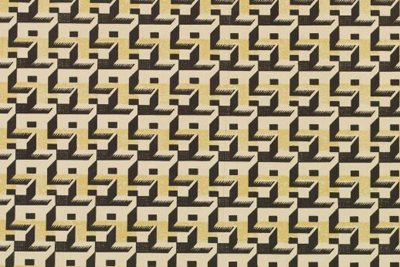
The two characters are, I suppose, some sort of angelic bellboy or tailor or waiter. I can’t think of what else they might represent in those outfits. Kayser seems to be an American company, made and sold under license in England and other countries. So these two might have originated under an American pen. The distinctive deco Kayser logo is almost A. M. Cassandre’s 1929 Bifur font but not quite.
This card was a present from a friend who found it in Norfolk – along with a nice Patons & Baldwins sign, that which I was also given. I like to think these two cards were old stock from a small local lingerie and dress shop. This one might have sat on a worn oak counter letting the customers know fully-fashioned fripperies were back in stock at last.
If Shelf Appeal were going to sit down for an illustrator’s tea party, as well as Mr Bawden and Mr Ravilious – I’d invite Ms Barbara Jones. She has appeared in these hallowed pages of code before and before that. And doubtless will again.
Today’s appearance was triggered by the small exhibition of her work currently on show at The Whitechapel Art Gallery. More specifically the 1951 Festival of Britain exhibition she curated there: Black Eyes and Lemonade. That gorgeous title apparently came from a line in a Thomas Moore poem and was chosen by Jones as it: ‘seems to express the vigour, sparkle and colour of popular art rather better than the words ‘popular art’.
A small room off the Whitechapel library has been given over to original plans for exhibition content, photos of the exhibition itself and some few perfectly formed exhibits that had been on show in 1951, many leant by Jones herself. Others by friends. The Whitechapel show is not nearly enough yet more than I’ve ever seen before on Jones. There are some of her book jackets on show too. Most of which I have already. Although I might deny I collect her work. Stupidly. Might deny – stupidly.
A super Airedale Terrier shaped fireplace is the largest survivor on show from Black Eyes and Lemonade. Closely followed by a fairground horse head. But more satisfying even are a pair of plump blue paper parrots joined by a piece of poignant old cotton thread. And some old plastic windmills of the child-running-on-the-beach variety.
Black Eyes and Lemonade had only previously been real to me through the catalogue that lists and lists lots of wonderful sounding exhibits. I looked for the parrots and windmills but think they must have come under more generic names like ‘Fairings and Swag’. But what is super nice about my catalogue are the neatly penned erudite notes at front and back from someone who must have visited the exhibition in 1951.
I got this catalogue years and years ago. But it is still one of my favourite (ever) graphic illustrations. I saw in the Whitechapel book shop that another of my favourite Jones things, her book Unsophisticated Arts, has just been reprinted in nearly all its glory. That I have a copy of in its original glory. But gosh would I like one of those small bits of ephemeral whatnottage that Jones collected herself and put on show back in 1951.
The small show of the show at the Whitechapel suggests the original exhibition was more wonderful than I had imagined. Jones was a peoples’ popular art folklorist of the first order. Nothing, it seems, was left off her shelves.
Jane goes to the Wars – as told on her typewriter, with sketches by a comrade in the A.T.S. is a little ditty about a well-to-do woman who joins the A.T.S. or Auxiliary Territorial Service. On joining-up Jane proceeds to fancy all her drill Sergeant-Majors and moves quickly up the ranks to Sergeant herself. Via eating very well in the mess (see illustration) and tobogganing on tin trays. Spiffing fun had by all.
I’m not one for collecting items with my name on them. I know what my name is. This booklet snuck in to my collection by virtue of its wartime niceness. Almost in spite of the title containing my name. It was printed by Raphael Tuck & Sons Ltd and is set in a typewritery typeface apropos of the title. The illustrations are lovely Vogue-ish things.
Written in the first person, it’s a piece of propaganda. Part of the drive to get women in to war work out of their (in this case) somewhat pampered lives. The A.T.S. was one of several auxiliary services that called up women from December 1941. And this red volume looks to be part of that particular recruitment drive. The famous Jane cartoon that ran in The Daily Mirror throughout the war must be the Jane reference here. But it doesn’t look like the same cartoonist drew our Jane. She also isn’t half as saucy as their Jane.
My favourite bit of this book is part of the title page illustration. A wrapped parcel is labeled ‘Pre-war glamour’ and Jane steps past it in her uniform – all curls, lipstick, kit bag and attitude.
Liverpool in 1955 was doubtless (in terms of weather) as Liverpool in 2013. Ergo, if you were living there then you might have needed a decent rainproof covering. And you might have wanted something with a little something about it. Say a plaid lining.
Burberry was one of the brands to go to for a decent rainproof covering in 1955. Not as ubiquitous and ‘fashion’ as they are these days, Burberry was a sensible brand then. They made serious items of clothing of quality for people who did outdoors things on and with animals. And for people in cities who wanted to look as though they did.
This rather nice giveaway booklet, stamped with compliments of Harold R Fox of Smithdown Road, Liverpool was: ‘The Burberry Diary – a Chronological Calendar of the Important Sporting and Social Events of the Year. The Months divertingly illustrated with Many Rare Prints.’
Jolly and nice hand-coloured prints by Gilray and others illustrate the vagaries of the weather month by month. They are accompanied by a small line drawing of the months’ coat. And in unsubtle acknowledgement of the vagaries of British weather, each page of the booklet carries the legend: ‘It’s always Burberry weather.’ The comprehensive events listed would have ensured your new Burberry got plenty of outings.
There was a very similar giveaway booklet in 1956. And perhaps more after that. The Google tells me modern Burberry dug this (or a similar) booklet out of their archives and used it as a t-shirt and scarf design – and perhaps on other things, too. But I like it best in its original paper booklet form.
On first glance this is a jolly nice deco-ish story book cover. On second glance this is a piece of corporate literature. It is the jolly nice cover that sold this to me, of course. Ever the shallow book buyer.
Published in 1931-2 by the Marshalsea Press, London, this book seems to have been issued as a souvenir of the opening of the new Dorchester Hotel. The title story ‘A Young Man Comes to London’ is a flowery but badly written (if not boring) short story about, erm, a young man coming to London. What makes it a bit more interesting are the line drawings by Cecil Beaton. Not the world’s best illustrator but his drawings are identifiable and nice because of whom he was.
The author of said story, Michael Arlen, has an interesting Wikipedia. An Armenian émigré, he was, it tells us, a bit of a dandy, writer and man about London town in the 1920s. Known particularly for driving a ‘fashionable yellow Rolls Royce’ and ‘engaging in all kinds of luxurious activities.’ Whatever that means. But perhaps some of those activities were played out in hotel rooms. And perhaps the Dorchester paid him in kind.
The rest of the book belies its interesting cover. A bit drier than you might hope. There is an essay on the thinking behind building the new hotel, then ‘An architect’s problem-how it was solved’. And worse: ‘Some facts and figures about the Dorchester’. Such as the fact that it took over 160 miles of electric cable to ‘satisfy requirements’ in the new building. Actually that is quite interesting. Then there are some foldout colour illustrations of the new hotel interiors. All looking implausibly spacious and actually lot less than deco than they should have been.
But back to that selling cover. No credit is given for illustrator of the tasty little stuck on label, which makes London look all New York. But the grand pink and grey zigzags are repeated on the endpapers and title page, where they are unfaded and joyous in their deco zinginess.
Shelf Appeal is not just about the appeal of old things. Walking down Oxford Street the other day (or doing the Oxford Street shuffle, so busy is it) I kept spotting these super Topshop paper carrier bags.
Topshop is an interesting one. Especially to anyone interested in retail history. It has made itself a covetable high street brand available to the many. Harder than it sounds, I should think.
The Topshop flagship store that larges it over Oxford Circus is a place to people watch. If not the place to people watch. Sitting waiting for a friend outside a changing cubicle there was some of the best (fashion) fun I ever had. It is a TV documentary waiting to happen.
I like the unapologetic nature of this brand. I also like their logo design; it makes of a cheesy 1970s sounding name something mutable and changeable yet constant.
The 3D cat is one of a few recent Topshop paper bags that have been worth noticing. It is also part of the cat meme going down at Oxford Circus at the moment – this print was also available on t-shirts and iPhone cases. And other cat prints were strewn across dresses, socks and (of course) thongs.
All adding up to nothing less than the cats meow.
Shelf Appeal does different things with her working day. Some digital work, some writing, some curating, some things other. During Milan fashion week just gone was a project to co-curate with Penny Martin a show for Italian shoe brand Pollini, who were celebrating their 60th anniversary and showing their Autumn / Winter 2013 collection.
We named the show Unpacking Pollini, to reflect the opening up of their archive of shoes for the first time. As well the title reiterated the main visual concept for the show – a tumble of shoe boxes and shoes. As if someone had just tried on everything in the collection. This installation was backed up by blown-up archival Pollini imagery from the very early 1970s and a screen pinned with fabulous polaroids and b&w photos of shoes and bags from the 1960s – 1980s, also found in the archive.
The ‘pile of boxes’ as it became unequivocally titled, took a day or so to build from the centre out. Some 450 boxes of different sizes and covered in matt white paper became an installation reaching 7m in length and about 2.5 m at its highest. And Shelf Appeal had the not too onerous task of displaying all the archive shoes with nothing but these boxes and the palest grey tissue paper. The labels for the archive display were beautifully simple cards with dates on them. Designed (as were the rest of the exhibition graphics) by Veronica Ditting.
The show was up for 4 hours. We ran a live Shoe Social during that time, taking polaroid’s of shoes with people in them and tweeting them out and pinning them up. I snapped this very accommodating gentleman who showcased a man’s and a women’s shoe at the same time. He didn’t have to be asked twice to strike a pose.
Ladybird books are lovely things. They pull gently at childhood memories if you are old enough to remember reading them. For younger sorts, there is any amount of dubious Ladybird product out there now, exploiting the imagery with none of the quality and intent of the original books.
I actually have a very few Ladybird books on my shelves. Shopping with Mother and one or two others. It would be very easy to get swept in to collecting the lot. They look great lined up together and the illustrations would keep me quiet for days. But plenty of other people are archiving Ladybird books, researching the titles, authors and artists in retentive detail.
One site has some great images of Ladybird books being made and sold, where I found this gem. This contextual material is much more interesting to me than exhaustive histories of versions and series’. A bit of book. A bit of window display. What could be nicer?
This window is crammed with Ladybird books and carries the words: The Craven Herald Ltd. The Herald, it seems, is a paper that has been the ‘Voice of the Dales since 1853′. I wonder if this window was in Craven and what the occasion was for the photo? It dates from the 1950s.
Had I been there at the time a bit of nose pressing against the window would surely have been happening.
Working in museums has almost cured me of collecting. I am happy for most things small and large to be in museums rather than in boxes in a cupboard near me.
I used to have many more textile and costume pieces. I was that person picking up all the interesting curtains and scarves in charity shops. But only a few framed pretties have remained in my care. This is one of them, a faded handkerchief. You might well wonder why this one stayed when others went.
Well, it’s a small handkerchief. That always helps – being small. And it’s a lovely subject and simple illustration. It is also, it seems to me, a bit of ephemeral textile. The corner reads ICI Procion. Now Procion dyes (the cold sort you use to do tie dye with) were made and made famous by ICI who patented them in 1954. So far so fair enough that they had a handkerchief made to promote them.
But this feels to me very much like a Lucienne Day design. Maybe it isn’t. But I want it to be. Not necessarily to give it design provenance, though that too. But because Lucienne’s husband Robin Day designed exhibition stands for ICI. And I jolly well love the idea she designed it for one of them. The timing is right and the subject matter is right and the style is right. The sliced pear is drawn in a manner very similar to Lucienne’s beloved leaf patterns that were strewn across her portfolio in the 50s and 60s.
Maybe she designed it as a giveaway on an ICI stand one 1950s wintertime. So people could blow cold red noses on a bit of very classy cotton.
This post is about a set of things. Not often read about here, it’s true. But some things shouldn’t be separated one from their others.
In the days before cling film, shrink-wrap and other see-through plastics – food was labelled by, erm, sticking a label in it. Usually a plain label, with just the food name written upon it. Or perhaps, more often, the name and the cost of the food by weight.
I usually prefer the plain no nonsense approach to labelling. But this set of illustrated labels (all below) are the exception that prove a little bit more is sometimes a little bit more.
I have no idea where these were made, although it was somewhere ‘foreign’ as one label has that stamped on it’s back. I am not very sure of their date but I’d hazard a guess at early 1920s, judging by the plastic. And they came to me squished in to a little cardboard box from somewhere in London. They have probably lain in that box since the 1920s.
But what thought has gone in to the illustrations for such a seemingly inconsequential set of things. The egg is joyous, the egg and cress more joyous. The waving crab would sell itself to a vegetarian. The monocled salmon comes smoked, or not. One cheese seems to be turning its nose up at a smellier cheese. The ham has a tutu and the cucumber wears what appear to be hobnail boots. The poor old chicken, meanwhile, seems to be in his cooking pot already.
I can only imagine how these must have perked up the food display in a grocer shop. For they most certainly perk me up.